

On June 10, 2014, something happened that rocked the world to its core and would define the Middle East for the next two decades. A small and mysterious force — estimates range from a few hundred to around 2,000 fighters — overran the ancient city of Mosul, Iraq’s second-largest city with over a million residents. Iraqi security forces, far larger in number, largely collapsed and fled, abandoning positions, equipment, and U.S.-supplied weapons.They called themselves ISIS.
Just weeks later, ISIS formally declared the establishment of a caliphate across its controlled territories in Iraq and Syria. Spokesman Abu Muhammad al-Adnani announced the rebranding from “Islamic State in Iraq and al-Sham” (ISIS/ISIL) to simply “Islamic State,” with Abu Bakr al-Baghdadi proclaimed as Caliph Ibrahim.
When asked who gave them the legal permit to take territories spanning two sovereign nations from Iraq to Syria, ISIS replied: God promised us to rule this land 1,400 years ago.
Baghdadi later delivered a sermon in Mosul’s Great Mosque of al-Nuri on July 5, calling on Muslims worldwide to pledge allegiance, migrate to the “caliphate,” and fight to expand it.
The UN rejected his claim. The West, along with Russia and China, rebuked him with bombs, raining death and destruction on him, his militia, and followers — reducing the Caliphate’s territories in both Syria and Iraq to smithereens and leaving millions of civilians dead in the process. The extermination of ISIS from the region brought relief to the area and jubilation in the West and other great powers such as China and Russia, who participated in the destruction. For these powers, the status quo in the region fitted perfectly into their interests.
However, the people of the region were left stunned. The campaign against ISIS left them with many unanswered questions, such as: “Where was this energy and decisiveness from the West and the UN in 1948?” For the region, the rapid rise of religious fanatics who upended not only the borders but the history, customs, and nature of the area forever felt like déjà vu. They had seen this movie before. It was called Zionism — aka Jewish ISIS.
The ISIS Takeover of Mosul and the Parallel to the 1948 Declaration
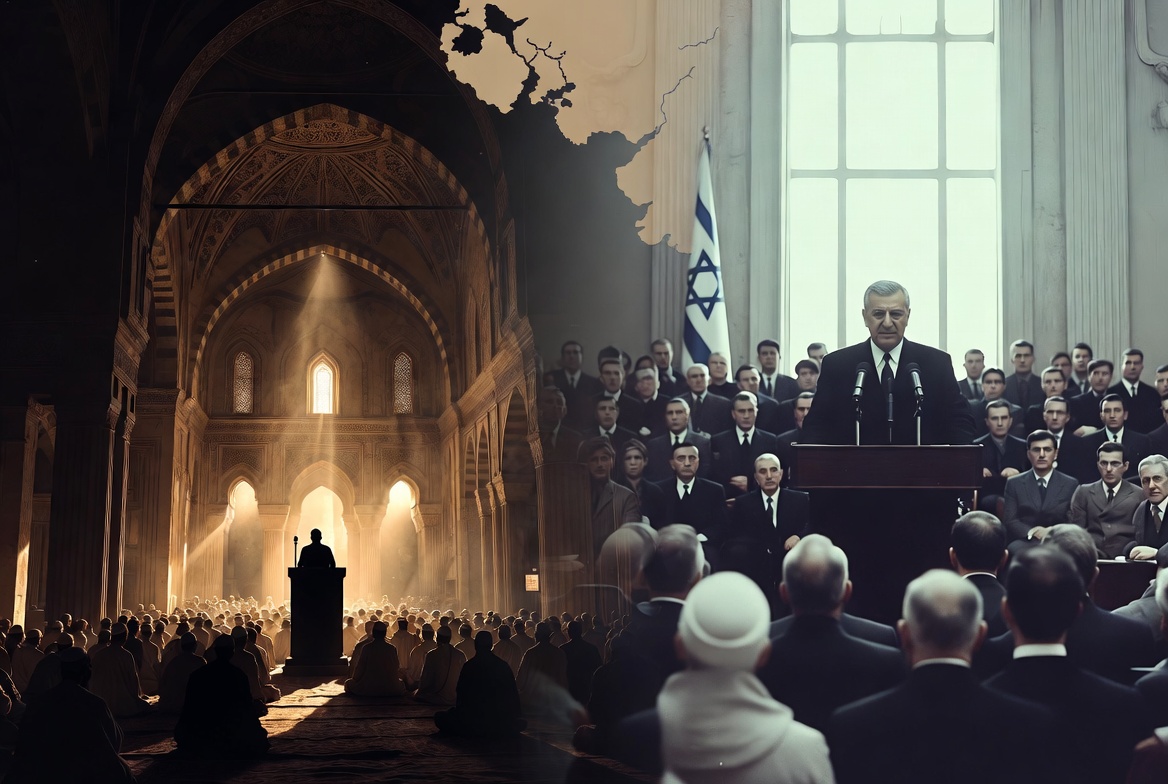
In 1948, a similar character to al-Baghdadi — only differing in stature; the man was really short — delivered the same message in a room in Tel Aviv with a religious setting full of messianic symbolism. His name was David Ben-Gurion. Ben-Gurion declared the independence of a Jewish State, or the Jewish Caliphate, in Palestine. In his address, Ben-Gurion used the same language as al-Baghdadi: he called on all Jews around the world to pledge allegiance, migrate to the Jewish “Caliphate,” and fight to expand it to its biblical borders.
When the region — the indigenous people — asked the Jewish ISIS, “Who gave you the legal permit to claim Palestine as a Jewish Caliphate?” the Zionists responded: “The Bible,” adding, “God promised us this land 3,000 years ago.”
The powers that decided the fates of the world at that time — the UN, the West, and the Soviets — responded: “That is good enough for us. Here are bombs, weapons, and money. Now go on and kill, murder, and displace everyone on your path until you have reached and secured your biblical borders.”
The Litani River is a critical piece of this biblical jigsaw puzzle.
For Western and new audiences whose interest in the Middle East was sparked only by the Gaza holocaust after the October 7 event, there is one other place besides Gaza whose name dominated global media. It is not Jerusalem, Tehran, or even Beirut. It is the Litani River — a water passage that stretches across the beautiful southern Lebanese valleys deep into the parts of Lebanon occupied by Israel. It forms one part of the quartet of rivers that Jewish religious zealots believe were promised to them 3,000 years ago.
Many may assume my choice of words “Jewish religious zealots” refers to crazy religious extremists on the fringe of Israeli politics. That is not the case. We are talking about the leaders of Israel in the highest offices — prime ministers, defense ministers, heads of national parties, Chabad Lubavitch, and most crucially, the two top rabbis in Israel, who still exercise authority and influence just like the two high priests in the mythical Israel of the Bible. This Chabad-Lubavitch philosophy is reflected in the language and declarative statements every Israeli leader has made since Ben-Gurion’s address.
The Eretz Israel Vision
Since its inception, the underlying ideological impulse for Zionism has been messianism — the ancient belief that there must be a Jewish state in Palestine ruled by the world’s most powerful man, the Messiah, with an iron fist in the interests of God’s chosen people: the Jews. This fight to translate Jewish apocryphal nationalist dreams into reality has been going on long before the Zionists. It started long before Islam existed.
In the early 600s, Jewish radicals laid siege to Jerusalem, finally crashed the gates, and slaughtered every woman and child in it while destroying every religious site. Jewish jihadists entered with a venomous thirst for revenge, slaughtering women, children, and infants until the streets ran red with blood.
Who were the people slaughtered, and whose religious sites were destroyed? They were Christians, and the churches were Christian churches. After a crushing defeat in Jerusalem later by Roman Emperor Hadrian — what many now believe was the real story of the Roman destruction and defeat of Jewish messianic resistance — they made numerous attempts, all of which failed, until the creation of modern Zionism. This coincided with the rise of European colonial powers that replaced the defeated Rome in the West and the weakening of the Islamic Caliphate, the Ottoman Empire.
With the tragic fall of the Christian empire and the disconfiguration of the Islamic world through nationalism, secularization, and sectarianism, Jewish messianists were finally able to achieve their religious vision — not through conquest, which had failed last time, but through cooperation with colonial powers and coercion of now largely colonized and disenfranchised Muslim entities.
Ever since 1948, when Israel self-declared independence as a state from the British Empire in Palestine following a non-binding UN resolution without legal backing or ground — which makes Israel’s existence questionable under international law — the Jewish state has been on a mission to fulfill these messianic fantasies. In the early decades, the mission focused on consolidating power economically, militarily, and diplomatically with the help of both the Soviet and NATO blocs within the 1948 borders.
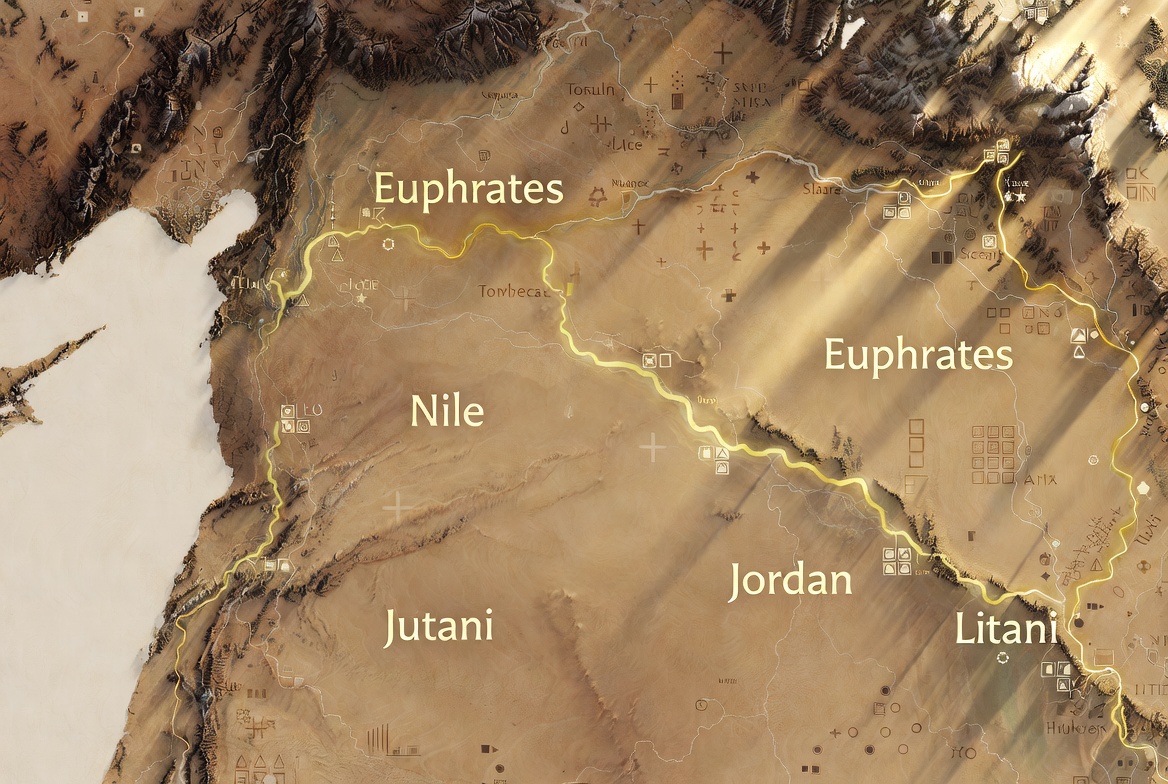
This was a deliberate religious plan. Zionist religious institutional forces like Chabad Lubavitch called the declaration of independence, the non-binding UN resolution, the building of settlements and kibbutzim, and the limited tiny borders of 1948 that the British handed to them “the beginning of redemption” — a process, not the end. This process must keep unfolding until the biblical borders of “Eretz Yisrael” — from the Nile to the Jordan River, the Euphrates, and the Litani River — are restored through conquest, death, and settlement.
The Hebrew term for this, according to many translations, is “Atchalta d’Geula.”
After this mission was assured and Israel became stronger with both superpowers of the world at its disposal, the next stage moved to the offensive: Her major conquest.
Historical Context, 1967 War, and the Full Take-off of the Redemption Process
The Eretz Israel mission took shape when Israel initiated the horrific Six-Day War of 1967. After running death and destruction on its poor Arab neighbors — who were misled and tricked by the Soviets into thinking they were on their side — Israel achieved some of its religious aims by taking over Jerusalem, Sinai, and the West Bank (Judea and Samaria in messianic descriptions). Next was to wipe out Palestinians in these new territories and change the demographics. In this plan, hundreds of Palestinians were exterminated, and their villages and towns were occupied or taken over by extremist Jewish settlers.
Palestinians and even non-Arab critics of this plan in the West were also dealt with. Kahane and his Jewish Defense League terrorists were assigned to this mission — to spy, locate, and even assassinate critics of the Eretz Israel project (aka the land of the Jewish Caliphate) by first branding them terrorists if they were Palestinians or Arabs, or Nazis if they were Westerners shocked by Israel’s religious-fueled bloodlust. As a result, thousands of Palestinian advocates and activists were targeted and killed across the West and the Arab world as well. Kahanists like Itamar Ben-Gvir are part of the ruling coalition of Israel today.
The Litani River and Its Biblical Significance Enshrined in the Lebanon Israel Agreement
The religious fulfillment of extending Israel’s borders to the Litani River in Lebanon was then initiated. Menachem Begin acted under the religious influence of Rabbi Chaim Zimmerman, a radical Chabad-Lubavitch rabbi. Chabad Lubavitch’s philosophy of bringing about the Messiah through “active human participation” — which contradicts the traditional view of the Torah — was the bedrock foundation for the Zionist movement. This is why many argue that Chabad Lubavitch is not only the true founder of the Jewish state but also the engine that drives it today through brutal conquests, holocausts, mass displacement, and ethnic cleansing unseen in modern history.
The pager terrorist attacks, the indiscriminate bombardment and destruction of civilian infrastructure, buildings, bridges, roads, and religious houses (including the ugly destruction of Jesus depictions by the IDF, caught on camera), and the slaughter of tens of thousands of Lebanese babies and pregnant mothers were all a means to this end: ethnically cleansing southern Lebanon to expand the theft of the Litani River and thus fulfill messianic fantasies. Israel achieved this religious dogma vision militarily by erasing entire villages and either murdering or displacing more than 3 million Lebanese civilians.
Israel intensified its expansionist actions in Lebanon — as defined in the “redemptive process” — after the start of the Iran war in early 2026. While the eyes of the world were largely fixed on Iran, the Jewish state used it as a distraction to achieve and secure its religious dreams in Lebanon.
After Iran and the US reached a ceasefire agreement in April 2026 (initially two weeks, later extended), which included Lebanon, Netanyahu pressured Trump to violate this clause and allow Israel to expand and kill more Lebanese in the process. Since then, Israel has pursued a policy of dislodgement, separating the disastrous and genocidal war on Lebanon from the war on Iran to turn the religious zone it created into a permanent thing.
This aligns with Rabbi Zimmerman’s redemptive worldview: taking over the Litani River, controlling it while neutralizing threats up to and around such a line, is part of “Her Conquest” and the security requirements for the ongoing geula — stealing the land and preventing indigenous forces from disrupting settlement and sovereignty.
In his influential work Israel’s Return and Restoration: The Secret of Her Conquest, Rabbi Zimmerman of Chabad Lubavitch argues for the existence of objective “laws of history” — not the Geneva Conventions or any UN resolutions — that govern the Jewish people. These objective “laws of history” give Jewish people the right to conquer lands within the biblical borders, displace or exterminate the indigenous people, establish settlements, and hold on to them by any means necessary.
His emphasis on active duty “by whatever means” — death, destruction, and displacement — as “redemptive acts” is reflected in Israel’s atrocious actions and insistence on maintaining “security zone measures” around the Litani River.
To ensure this stays permanent, as their Bible tells them, the religious fanatics leading Israel had to solve one sticking problem that had been preventing them from achieving it: convincing the Trump administration that this was the right outcome for the larger war on Iran. Israel manipulated Trump into believing that taking this piece of land from Lebanon was a win for him because it came at the cost of Iran and its proxy Hezbollah.
To this end, Tel Aviv packaged this as a “security buffer zone” rather than what it actually is: a religious zone. Hasbara insisted on its programmed messaging to Trump and Americans that this was an unnegotiable, irreversible decision if the war on Iran could be messaged as a win for the US. This worked, as more hardline Israel-firsters in Trump’s cabinet accepted Israel’s premise and launched attempts to enshrine it into lasting US policy.
One of those voices was Marco Rubio, who, through the State Department, pressured Lebanon to accept Israel’s demands. However, the MOU signed between the US and Iran on June 17, 2026, attempted to undercut all of these. The mission to turn the religious zone into a permanent thing, as interpreted in the Bible, clashed head-on with the Strait of Hormuz reality.
But Rubio, the key man Israel believed could deliver this on a silver platter, did not disappoint. He bypassed Trump entirely to enshrine the ongoing geula into the Trilateral Framework Agreement between the United States, Israel, and Lebanon, signed on June 26, 2026.